

Disclaimer

This article is for educational purposes only and should not be considered medical advice. Consult a qualified healthcare professional before starting any new supplement, especially if you have medical conditions or take prescription medications.
You know that feeling.
You wake up after a full night’s sleep, grab your morning coffee, sit down at your desk—and yet your brain still feels like it’s running on 20% battery.
The to-do list is staring at you. The motivation isn’t there. The focus comes in short bursts before disappearing again.
For many people, another cup of coffee seems like the obvious answer.
But what if the problem isn’t just energy?
What if your brain simply doesn’t have enough raw materials to keep up with the demands you’re placing on it?
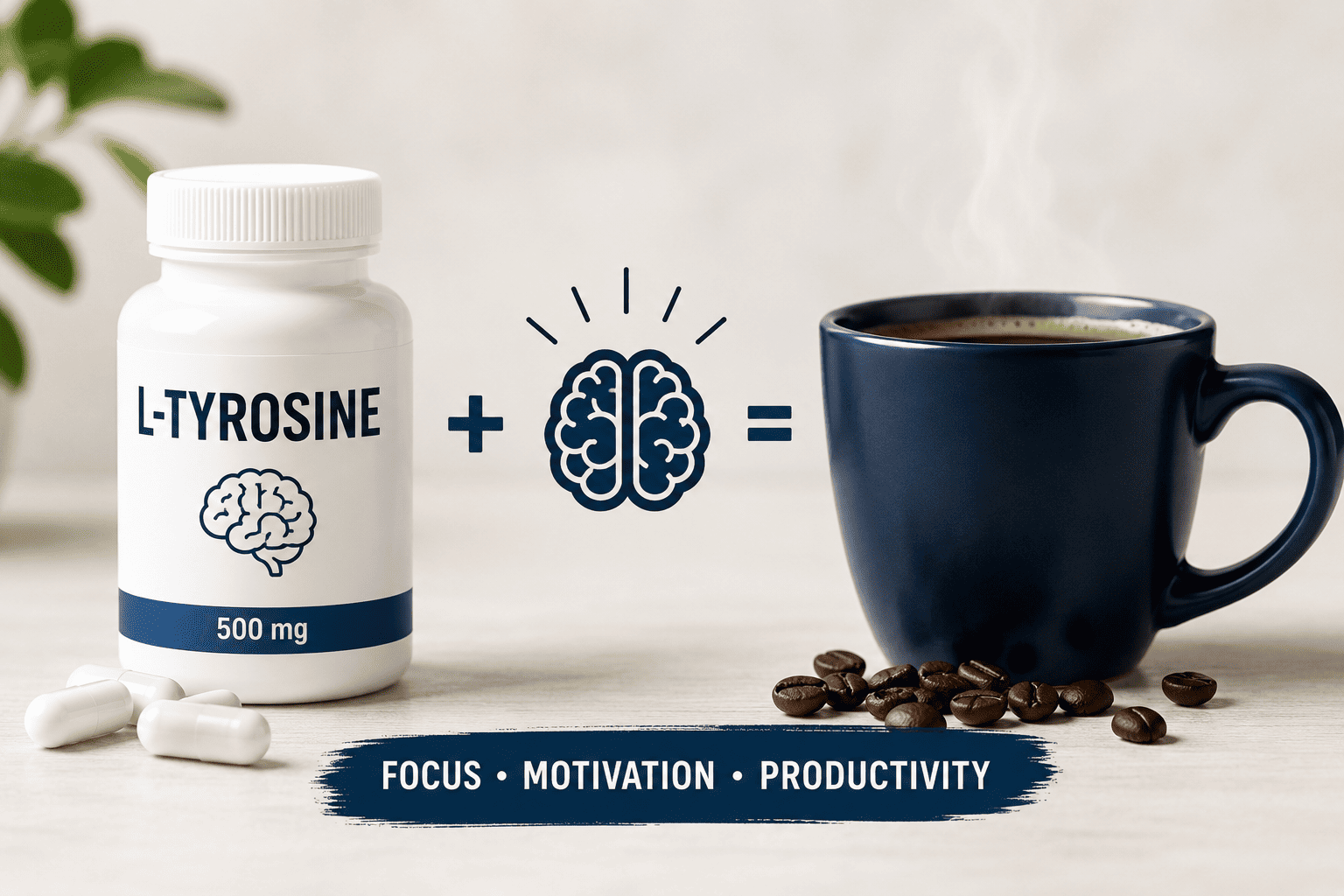
That’s exactly why many people are pairing their morning coffee with L-Tyrosine—and some swear it’s one of the most effective productivity combinations they’ve ever tried.
But is there actual science behind this stack, or is it just another wellness trend?
Let’s find out.
Why Coffee Sometimes Stops Working
Most of us love coffee for one simple reason:
It works.
Caffeine blocks adenosine, a chemical that tells your brain you’re tired, making you feel more awake and alert.
But here’s something many people don’t realize:
Coffee doesn’t create energy.
It simply removes one of the brakes.
If you’ve been under stress, dieting aggressively, sleeping poorly, or pushing your brain for weeks without recovery, caffeine can only do so much.
Eventually, you may find yourself drinking more coffee while feeling less productive.
Sound familiar?
That’s where L-Tyrosine enters the conversation.
What Exactly Is L-Tyrosine?
L-Tyrosine is an amino acid that your body uses to produce important neurotransmitters, including:
L-Tyrosine → L-DOPA → Dopamine → Norepinephrine → Epinephrine
These chemicals influence:
- Motivation
- Focus
- Mental energy
- Alertness
- Stress resilience
- Goal-directed behavior
Think of dopamine as your brain’s motivation currency.
It’s not simply the “feel-good hormone” people often describe online.
Dopamine helps you initiate tasks, stay engaged, solve problems, and pursue rewards.
Without adequate dopamine signaling, even simple tasks can feel exhausting.
The Theory Behind Coffee + L-Tyrosine
The reason this stack has become so popular is because both substances work differently.
Coffee (Caffeine)
Coffee helps by:
- Blocking adenosine receptors
- Increasing alertness
- Improving reaction time
- Reducing perceived fatigue
But it doesn’t directly provide the building blocks needed for neurotransmitter production.
L-Tyrosine
L-Tyrosine provides the raw material your body uses to produce:
- Dopamine
- Norepinephrine
- Epinephrine
In theory, combining the two creates a powerful partnership:
Coffee helps you feel awake.
L-Tyrosine helps support the brain chemicals responsible for motivation and focus.
At least, that’s the idea.
But what does science actually say?
What Research Says About L-Tyrosine
Here’s where things get interesting.
L-Tyrosine isn’t a miracle supplement, and it certainly isn’t a natural version of prescription stimulants.
However, it does have some legitimate research behind it.
Studies have found that L-Tyrosine may help preserve cognitive performance during stressful conditions, including:
- Sleep deprivation
- Cold exposure
- Military training
- High mental workload
- Intense psychological stress
Researchers believe this happens because stress rapidly uses up dopamine and norepinephrine, and providing more tyrosine helps maintain their production.
The evidence is strongest when people are under pressure—not necessarily when they’re already functioning at their absolute best.
And honestly, how many of us aren’t under some form of stress these days?
Why So Many High Performers Use This Stack
The people who tend to benefit most often include:
Remote Workers and Entrepreneurs
Long workdays require sustained mental energy.
Many find that coffee alone creates alertness without necessarily improving motivation.
Adding L-Tyrosine may help create smoother focus with fewer energy crashes.
Students
During exam periods, mental demands increase dramatically.
Some students use L-Tyrosine to support concentration and working memory alongside moderate caffeine intake.
People on Calorie Deficits
Dieting places significant stress on the body.
Reduced calories mean less energy availability and sometimes lower motivation.
This is one reason L-Tyrosine has gained popularity among people losing weight or using GLP-1 medications.
Shift Workers
Lack of sleep is one of the conditions where L-Tyrosine has shown some of its most promising research.
While it won’t replace sleep, it may help maintain cognitive performance during unavoidable sleep deprivation.
My Experience Isn’t Necessarily Your Experience
One thing that’s important to remember:
Supplements are highly individual.
Some people describe coffee and L-Tyrosine as a game-changer for productivity.
Others notice only subtle differences.
And some notice nothing at all.
That’s completely normal.
Human biology is complicated.
Genetics, stress levels, diet, sleep quality, and existing neurotransmitter levels all play a role.
The goal shouldn’t be chasing superhuman productivity.
It should be supporting your brain so it can perform at its natural best.
The Most Common Way People Take It
A typical approach looks something like this:
Morning Productivity Stack
☕ One cup of coffee (100–200 mg caffeine)
💊 L-Tyrosine (500–1,000 mg)
🥚 High-protein breakfast
💧 Plenty of water
Protein matters because amino acids compete for absorption, and adequate nutrition helps maintain healthy neurotransmitter production.
Many users prefer taking L-Tyrosine early in the day because taking it too late may interfere with sleep.
Who Should Probably Avoid It?
L-Tyrosine isn’t for everyone.
People with the following conditions should speak with their healthcare provider first:
- Hyperthyroidism
- Graves’ disease
- Certain migraine disorders
- People taking MAOI antidepressants
- Individuals sensitive to stimulants
Even natural supplements deserve the same level of respect as medications.
More isn’t always better.
The Bigger Question Nobody Talks About
Sometimes, when we’re searching for the perfect productivity stack, we’re really asking a different question:
Why am I so exhausted in the first place?
No supplement can replace:
- Quality sleep
- Adequate protein
- Stress management
- Regular exercise
- Recovery time
- Human connection
Coffee and L-Tyrosine might help support mental performance.
But they’re tools—not solutions to chronic burnout.
And that’s an important distinction.
So, Is Coffee and L-Tyrosine the Ultimate Productivity Stack?
Maybe.
For people dealing with stress, heavy workloads, calorie deficits, or mild brain fog, it can be a useful combination that supports both alertness and the brain chemicals involved in motivation and focus.
The science behind L-Tyrosine is promising, particularly during stressful conditions, while caffeine remains one of the most studied performance-enhancing compounds in the world.
But the real secret to productivity isn’t found in a supplement bottle.
It’s found in building a lifestyle that allows your brain to thrive.
The coffee and L-Tyrosine stack simply gives some people a little extra help along the way.
Sources and further reading
Editorial note: this article is educational and should not replace guidance from a qualified healthcare professional. Source links are provided to help readers verify key claims and safety context.
- Jongkees et al., 2015 — Effect of tyrosine supplementation on clinical and healthy populations under stress or cognitive demands (PubMed)
- Deijen & Orlebeke, 1994 — Effect of tyrosine on cognitive function and blood pressure under stress (PubMed)
- WebMD — Phenylalanine: uses, side effects, precautions and interactions
- Mayo Clinic — Phenylalanine, PKU, and precautions

