

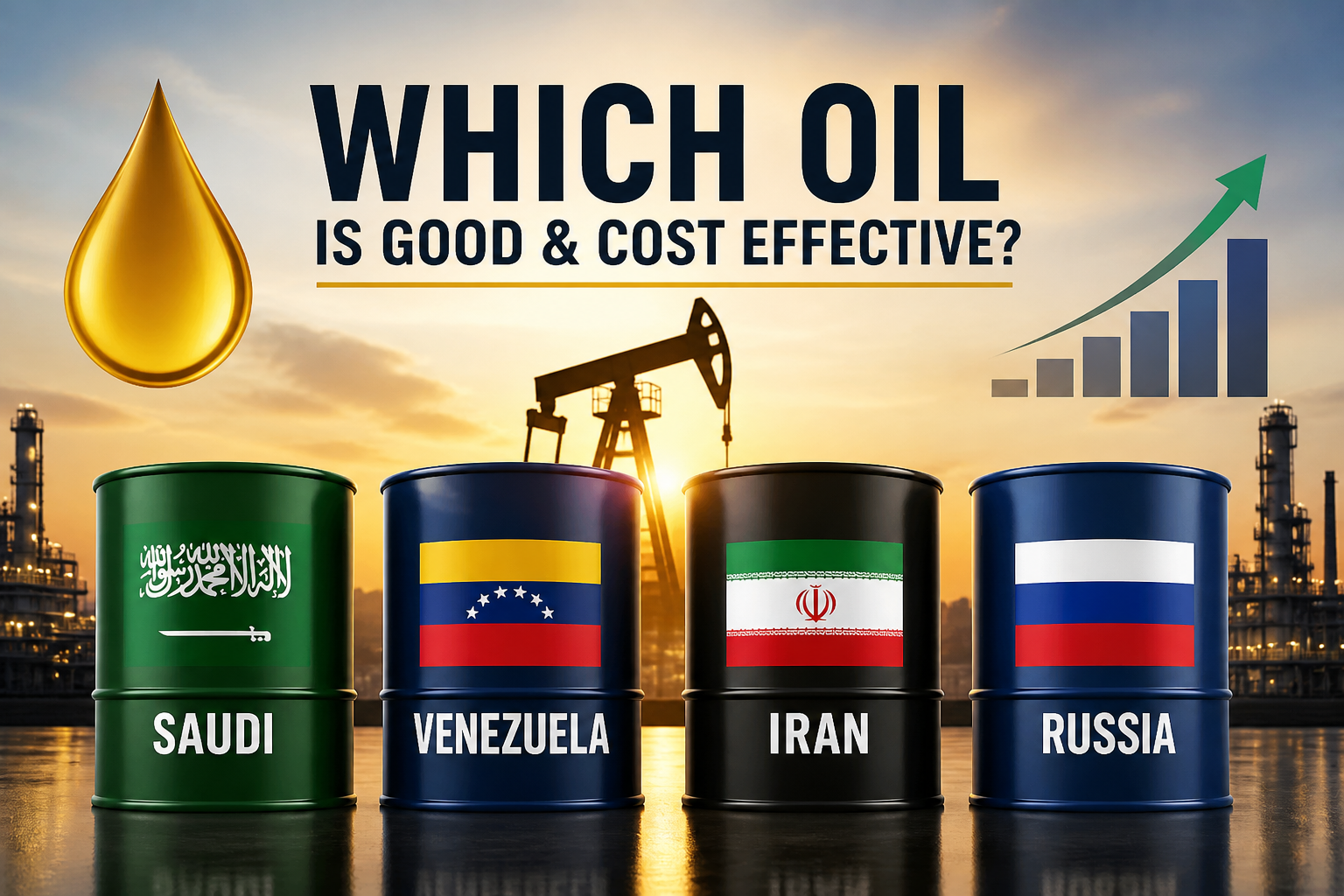
When people hear the word “oil,” they usually imagine the same black liquid coming out of the ground everywhere. But in reality, not all crude oil is the same. Some oil is easier to refine, cleaner to process, cheaper to produce, and more profitable for countries and companies.
This is why Saudi oil, Russian oil, Iranian oil, and Venezuelan oil are all valued differently in the global market.
Let’s break it down in a simple and human-friendly way.
First: What Makes One Oil Better Than Another?
Crude oil is mainly judged by two things:
1. How “Light” or “Heavy” It Is
This is measured using something called API gravity.
- Light oil = easier and cheaper to refine
- Heavy oil = thicker, harder, and more expensive to process
Think of it like this:
- Light oil flows more like water
- Heavy oil flows more like honey or tar
2. Sulfur Content (“Sweet” vs “Sour”)
- Sweet oil = low sulfur = cleaner and easier to refine
- Sour oil = high sulfur = needs more expensive treatment
Low-sulfur oil is preferred because modern environmental rules require cleaner fuel.
Comparing Major Oil Producers
🇸🇦 Saudi Oil – The Global Favorite
Saudi Arabia produces some of the world’s most commercially valuable oil because it is relatively easy and cheap to extract.
Saudi crude is usually:
- Medium to light
- Moderate sulfur
- Cheap to produce
- Stable in supply
Saudi oil is popular because:
- Production costs are among the lowest in the world
- Saudi Arabia has massive infrastructure
- Refineries around the world are designed for it
This is why Saudi Arabia has huge influence in global oil pricing and in organizations like OPEC.
Why refiners like Saudi oil:
✅ Reliable supply
✅ Cost efficient
✅ Good balance between quality and price
✅ Produces strong gasoline and diesel output
For many countries, Saudi oil is considered the “safe and dependable” option.
🇻🇪 Venezuelan Oil – Huge Reserves, But Difficult Oil
Venezuela has some of the largest oil reserves in the world, even larger than Saudi Arabia on paper. But there is a big problem:
Most Venezuelan oil is extra-heavy crude.
That means:
- Very thick
- Hard to transport
- Expensive to refine
- Requires advanced refineries
Some Venezuelan crude is almost like asphalt or tar.
Why Venezuelan oil struggles:
❌ Expensive production
❌ Complex refining
❌ Infrastructure problems
❌ Sanctions and political instability
Even though Venezuela has huge reserves, turning that oil into profitable fuel is much harder.
🇮🇷 Iranian Oil – Strong Quality but Sanction Problems
Iran produces mostly medium-heavy crude with moderate sulfur content.
Iranian oil is:
- Better quality than Venezuelan oil
- Heavier than premium U.S. oil
- Commonly used by Asian refineries
Advantages:
✅ Good refinery compatibility
✅ Competitive pricing
✅ Large reserves
Problems:
❌ International sanctions
❌ Banking and shipping restrictions
❌ Political risk
Because of sanctions, Iran often sells oil at discounts to buyers willing to take the risk.
🇷🇺 Russian Oil – Cheap and Important for Asia
Russian crude, especially “Urals,” is medium-heavy and sour.
Russia became extremely important because:
- It exports huge volumes
- It sells at discounted prices during sanctions
- India and China increased purchases heavily in recent years
Why buyers still like Russian oil:
✅ Cheaper than many alternatives
✅ Large supply availability
✅ Works well in complex refineries
Downsides:
❌ Higher sulfur
❌ More refining needed
❌ Political and sanction risks
Still, many countries buy Russian oil because lower prices can offset refining costs.
So Which Oil Is Actually “Best”?
There is no single perfect answer.
It depends on:
- Refinery type
- Transportation costs
- Political risk
- Environmental regulations
- Fuel demand
But generally:
| Country | Oil Quality | Refining Cost | Production Cost | Market Reputation |
|---|---|---|---|---|
| Saudi Arabia | Very Good | Moderate | Very Low | Excellent |
| Venezuela | Difficult | Very High | High | Challenging |
| Iran | Good | Moderate-High | Moderate | Restricted by sanctions |
| Russia | Medium | Moderate | Moderate | Cheap but politically risky |
Which Oil Is Cheapest to Produce?
Saudi Arabia is one of the cheapest producers globally because its oil fields are easier to access and extract.
This gives Saudi Arabia a massive advantage during low oil price periods.
Countries with expensive oil production struggle more when global oil prices fall.
Why Oil Quality Matters So Much
Better quality oil means:
- More gasoline
- More diesel
- Easier refining
- Lower pollution cleanup costs
- Higher profits
Heavy and sour crude usually sells at a discount because refining it costs more.
That’s why light sweet crude from places like the U.S. and parts of the Middle East often gets premium prices.
Final Thoughts
Oil is not just about how much a country has underground. The real value depends on:
- Quality
- Extraction cost
- Refining complexity
- Infrastructure
- Politics
- Global demand
Saudi Arabia became powerful not only because it has oil — but because its oil is relatively cost-efficient and easy for the global market to use.
Meanwhile, countries like Venezuela have massive reserves but face major challenges because their crude is harder and more expensive to refine.
In the modern energy world, “easy oil” usually wins.

